
A Pitman schedule (also called a Pitman shift schedule or Pitman work schedule) covers a post 24 hours a day with four crews working 12 hour shifts on a 14 day cycle. Each crew works 7 shifts and has 7 days off per cycle, never works more than 3 days in a row, and gets every other weekend off as a three day weekend. The pattern averages 42 hours a week, which sounds tidy until payroll runs it. Depending on the day your workweek starts, the same rota produces either 208 or 520 overtime hours per employee per year in the US.
Below you will find the full 14 day calendar, the fixed and rotating versions, how the Pitman schedule differs from the 2-2-3 (Panama) and DuPont rotations, the overtime math under US, UK and EU rules, the staffing you need, and the mistakes that make the pattern expensive.
- What is a Pitman schedule?
- Pitman schedule example: the 14 day calendar
- Fixed vs. rotating Pitman schedule
- Pitman vs. 2-2-3 (Panama) and DuPont
- Pitman schedule hours and overtime in the US
- Pitman schedule rules in the UK and EU
- How many people a Pitman schedule needs
- Pitman schedule pros and cons
- How the Pitman schedule scores against shift design guidelines
- Common mistakes when running a Pitman schedule
- Managing leave on a Pitman schedule with actiPLANS
- FAQ
What is a Pitman schedule?
The Pitman schedule is a 24/7 shift pattern built on four crews, two 12 hour shifts a day (typically 7:00 to 19:00 and 19:00 to 7:00), and a cycle that repeats every 14 days. It started in law enforcement and is now common in police departments, dispatch centers, hospitals, corrections, utilities, call centers and continuous manufacturing.
Each crew follows the same sequence of work and rest days:
- work 2 days, off 2 days
- work 3 days, off 2 days
- work 2 days, off 3 days
The numbers that follow from it:
- 7 shifts and 84 hours per 14 day cycle, so an average of 42 hours a week
- 182 shifts and 2,184 scheduled hours a year (26 cycles), with 182 days off
- never more than 3 consecutive work days and never more than 3 consecutive days off
- a Friday to Sunday weekend off every other week, if the cycle starts on a Monday
- two shift handovers a day instead of three on an 8 hour system
You will also see it called 2-3-2 or 2-2-3, after the blocks of work days. Sources name it inconsistently, and the comparison section below untangles the labels.
Pitman schedule example: the 14 day calendar
In this example, Crews A and B share the day shift and Crews C and D share the night shift. Crew A and Crew C follow the sequence above; Crews B and D work exactly the days A and C have off. Every day has one crew on days and one crew on nights, so this table doubles as a Pitman schedule calendar.
| Cycle day | Day shift (7:00 to 19:00) | Night shift (19:00 to 7:00) |
|---|---|---|
| 1 (Mon) | Crew A | Crew C |
| 2 (Tue) | Crew A | Crew C |
| 3 (Wed) | Crew B | Crew D |
| 4 (Thu) | Crew B | Crew D |
| 5 (Fri) | Crew A | Crew C |
| 6 (Sat) | Crew A | Crew C |
| 7 (Sun) | Crew A | Crew C |
| 8 (Mon) | Crew B | Crew D |
| 9 (Tue) | Crew B | Crew D |
| 10 (Wed) | Crew A | Crew C |
| 11 (Thu) | Crew A | Crew C |
| 12 (Fri) | Crew B | Crew D |
| 13 (Sat) | Crew B | Crew D |
| 14 (Sun) | Crew B | Crew D |
Follow one crew down the table and you get its fortnight. Crew A works Monday and Tuesday, rests Wednesday and Thursday, works Friday to Sunday, rests Monday and Tuesday, works Wednesday and Thursday, and rests Friday to Sunday. Crew B has the mirror image. On day 15 the cycle starts again.
If you build this in a spreadsheet, enter one crew’s 14 day string (W W O O W W W O O W W O O O), copy it for the partner crew with W and O swapped, and repeat the block 26 times for a year. That is the whole Pitman schedule template, and nothing else is needed to fill a year.
Fixed vs. rotating Pitman schedule
The 14 day calendar is the same in both versions. What changes is whether a crew stays on one shift.
Fixed Pitman schedule. Crews A and B always work days, Crews C and D always work nights. People keep one sleep rhythm, and you can hire into nights by preference, usually with a night differential. The cost is that the night crews never leave nights unless they transfer, which can feel like a second tier inside the same team.
Rotating Pitman schedule. Crews swap between days and nights at set intervals. The most common version described by scheduling vendors swaps every two weeks: days for one cycle, nights for the next, on a 28 day loop. Night work is shared evenly, and everyone pays the body clock cost of switching.
The UK Health and Safety Executive’s good practice guidelines for shift work recommend rotating either every 2 to 3 days or every 3 to 4 weeks, and allowing two nights of full sleep when switching between day and night shifts. A two week swap falls between those options. If you choose the rotating version, a 4 week block (two cycles on days, then two on nights) fits the guidance better, and placing each switch right after a crew’s three day rest block gives people the recovery time the HSE asks for.
Pitman vs. 2-2-3 (Panama) and DuPont
The names are a mess. Some guides call any 2 on, 2 off, 3 on rhythm a 2-2-3 schedule or Panama schedule and treat Pitman as a synonym. Others, including several shift planning vendors, use “Pitman” for the fixed version and “Panama” for the version where crews rotate between days and nights on a 28 day cycle. The work and rest days are identical either way, so the useful question is simply whether the crews rotate. Our guide to work schedule types covers the 2-2-3 schedule alongside other common patterns.
| Pattern | Cycle and longest stretch | What sets it apart |
|---|---|---|
| Pitman | 14 days; 3 days on, 3 days off at most | Usually fixed day and night crews; short cycle that is easy to read |
| 2-2-3 / Panama | 28 days when crews rotate; 3 days on at most | Same work and rest days as Pitman, with crews swapping days and nights |
| DuPont | 28 days; 4 shifts in a row, then 7 days off once per cycle | Mixes day and night blocks inside the cycle in exchange for a full week off |
If a full week off matters more to your team than short work blocks, read our breakdown of the DuPont schedule.
Pitman schedule hours and overtime in the US
An average of 42 hours sounds like 2 hours of overtime a week. Under the federal Fair Labor Standards Act it never works out that neatly, because overtime is counted per workweek and averaging over two or more weeks is not permitted. A non-exempt employee gets time and a half for every hour over 40 in a workweek. So the question is how the 7 shifts of a cycle fall into two workweeks, and that depends on where your workweek starts.
The FLSA lets an employer set a workweek as any fixed, recurring period of 168 hours that may begin on any day and at any hour. This is what that choice does to Crew A from the calendar above:
| Workweek starts on cycle day | Hours in week 1 / week 2 | Overtime hours per employee per year |
|---|---|---|
| 1 or 5 (Monday or Friday in this example) | 60 / 24 | 520 (20 per cycle × 26) |
| 2, 3, 4, 6 or 7 | 48 / 36 or 36 / 48 | 208 (8 per cycle × 26) |
The same holds for Crew B, whose weeks are the mirror image. Five of the seven possible start days give the 48 and 36 split; two put the three day work block and the following two day block in the same week and create a 60 hour week.
Worked example (illustrative figures). Take a base rate of $30 an hour. Straight time for 2,184 hours is $65,520 a year per person. The overtime premium is the extra half rate, $15, on each overtime hour:
- 60 / 24 split: 520 × $15 = $7,800 premium per person
- 48 / 36 split: 208 × $15 = $3,120 premium per person
- gap: $4,680 per person, or $18,720 a year for one post staffed by four crew members
Sensitivity: the gap equals 156 times the hourly rate, so every extra dollar of base pay adds $156 per person per year. At $40 an hour it is $6,240 per person.
Two cautions. The same regulation says a workweek may be changed only if the change is intended to be permanent and not designed to evade overtime, so set the anchor when you launch the schedule rather than switching it to cut a bill. Also, night shifts cross midnight. Starting the workweek at the shift change hour (for example 7:00) keeps every shift inside one workweek; otherwise each overnight shift is split between two weeks and the totals in the table move.
Police departments: the 7(k) exemption changes the math
Public agencies can pay law enforcement overtime on a work period of 7 to 28 days under section 7(k) of the FLSA. The overtime thresholds in 29 CFR 553.230 are 171 hours for a 28 day period, 86 hours for 14 days and 43 hours for 7 days. A police Pitman schedule puts 168 hours in 28 days and 84 hours in 14 days, so with a 14 or 28 day work period it carries no scheduled overtime at all. That is one reason the pattern is so common in police work. A 7 day work period brings the overtime back.
Daily overtime states and the hospital 8 and 80 system
Some rules count overtime by the day, which is bad news for 12 hour shifts. In California, hours over 8 in a workday are paid at time and a half, so each Pitman shift carries 4 overtime hours: 28 per cycle, or 728 a year, regardless of the workweek anchor. California’s alternative workweek arrangements are described around four 10 hour days or three 12 hour days, and half of all Pitman weeks run longer than that, so check the applicable wage order before you plan the budget.
Hospitals and residential care facilities can use the federal 8 and 80 system, with overtime after 8 hours a day and 80 hours in 14 days. It suits 8 hour rosters. On a Pitman schedule it backfires, producing the same 28 overtime hours per cycle as California, compared with 8 under a well anchored 40 hour workweek.
Pitman schedule rules in the UK and EU
Outside the US, the limits that matter are rest and night work rather than overtime pay. In Great Britain, the Working Time Regulations 1998 set the frame, and the EU Working Time Directive 2003/88/EC sets matching minimums across member states. Checked rule by rule, a Pitman schedule comes out like this:
- 48 hour average week (regulation 4): the Pitman average is 42 hours, so no opt out is needed unless overtime pushes people past 48 on average.
- 11 hours of daily rest (regulation 10): a 12 hour shift leaves 12 hours before the next one. Any overtime or a late handover eats directly into that margin.
- Weekly rest (regulation 11): 24 hours in each 7 days or 48 hours in each 14 days. With no more than 3 work days in a row, the pattern always meets it.
- Night work average (regulation 6): no more than 8 hours per 24 on average over 17 weeks. Our calculation for a night crew: 714 hours over 119 days, less 17 days of weekly rest entitlement, gives about 7 hours per 24, which is inside the limit.
- Hazardous night work: where night work involves special hazards or heavy physical or mental strain, regulation 6(7) caps it at 8 hours in any 24 hour period. A 12 hour night shift cannot be used for those roles, and Article 8 of the EU directive sets the same cap.
How many people a Pitman schedule needs
One post covered around the clock needs 168 hours a week. Four crew members averaging 42 hours give exactly 168, which means four people per post with zero slack. The first vacation day, sick call or training course has to be covered by someone working an extra 12 hour shift, usually at overtime rates.
A quick illustration of the gap: if each of the four people on a post takes 10 shifts of leave a year, the post loses 40 shifts, or 480 hours. That is 22% of one person’s 2,184 scheduled hours, before sick leave and training. This is why staffing guides for 24/7 rosters add a relief factor of around 20 to 25%, which in practice means about 5 people per continuously staffed post. A control room with 3 posts needs 12 people at minimum and about 15 once leave is covered.
The alternative is a relief pool: one or two people outside the four crews who fill gaps wherever they appear. It costs less than adding a fifth person to every post, as long as absences across posts do not peak at the same time. Our guide to shift scheduling covers coverage planning in more depth.
Pitman schedule pros and cons
Advantages
- Every other weekend off, and each one is a three day weekend.
- Nobody works more than 3 days in a row or is away more than 3 days, so people stay close to what is happening at work.
- Half the year off: 182 days, against about 104 weekend days on a Monday to Friday week.
- 182 commutes a year instead of about 260, and two handovers a day instead of three.
- A 14 day pattern is easy to memorize, so people can book appointments and courses months ahead.
- No scheduled overtime for police on a 14 or 28 day 7(k) work period.
Disadvantages
- 12 hour shifts are tiring, and nights are worse. The HSE advises limiting night shifts to 8 hours where the work is demanding, monotonous, dangerous or safety critical.
- Built in overtime in the US outside the 7(k) exemption: at least 208 hours per person a year, and more under daily overtime rules.
- No slack: four crews cover exactly 168 hours, so every absence leaves a 12 hour gap.
- Fixed nights fall on the same people, while rotating versions disrupt sleep for everyone.
- A 12 hour shift plus the commute often runs past daycare hours.
- Every crew works half of all weekends.
How the Pitman schedule scores against shift design guidelines
The HSE publishes ten good practice guidelines for designing shift work. They are guidance rather than law, but they make a good checklist for judging any pattern. The seven that apply directly to a Pitman schedule:
| HSE guideline | Pitman schedule | Verdict |
|---|---|---|
| Limit shifts to 12 hours including overtime | 12 hour shifts leave no room for overtime on the same day | Meets it only if no shift is extended |
| Limit night shifts to 8 hours for demanding or safety critical work | Night shifts are 12 hours | Does not meet it for those roles |
| Restrict long and night shifts to 2 or 3 in a row | At most 3 in a row | Meets it |
| Build regular free weekends into the schedule | Every other weekend off | Meets it |
| Avoid permanent night shifts; offer a choice of permanent or rotating | Fixed version keeps two crews on nights | Offer the choice, or rotate |
| Rotate every 2 to 3 days or every 3 to 4 weeks | Common rotating version swaps every 2 weeks | Use 4 week blocks instead |
| Allow 2 nights of full sleep when switching between days and nights | Each cycle contains a 3 day rest block | Meets it if switches follow that block |
Common mistakes when running a Pitman schedule
Letting payroll pick the workweek. The workweek is often inherited from the payroll system default. On a Pitman schedule that default can mean 520 rather than 208 overtime hours per person a year. Decide it deliberately when the schedule launches.
Counting leave in days when shifts are 12 hours. A policy written for 8 hour days breaks on 12 hour shifts. Grant 10 days of PTO and a Pitman worker can take 10 shifts, which is 120 hours of absence instead of 80. Grant 80 hours and the same worker gets 6.7 shifts. Pick one unit, write it into the policy and make the balance show it.
Approving leave without checking the crew. Each post has one person per crew on a shift. Two approved requests from the same crew on the same day leave a 12 hour hole that someone has to fill at overtime. Check crew coverage before approving, not after.
Treating four crews as enough. Four people per post works only when nobody is ever absent. Budget the relief factor or a relief pool from day one.
Extending 12 hour shifts. A late handover or a held over shift breaks both the 12 hour guideline and, in the UK and EU, the 11 hour rest rule. Plan handover time inside the shift.
Forgetting the night commute. People leave night shifts tired. Some employers arrange transport or shuttles for night and early morning shifts, and the HSE recommends fitting shift times to public transport where possible.
Ignoring holidays. Public holidays fall on whichever crew is scheduled, so the same crew can work Christmas several years in a row unless you track who worked which holiday and swap. Our guide to employee scheduling problems covers fairness issues like this.
Managing leave on a Pitman schedule with actiPLANS
Drawing the 14 day pattern takes an afternoon. Absences are what break it in month three, and that is where actiPLANS helps. Employees request leave on the web or in the mobile app, managers see the request on a shared timeline next to everyone else’s absences, and approval workflows can be set per leave type.
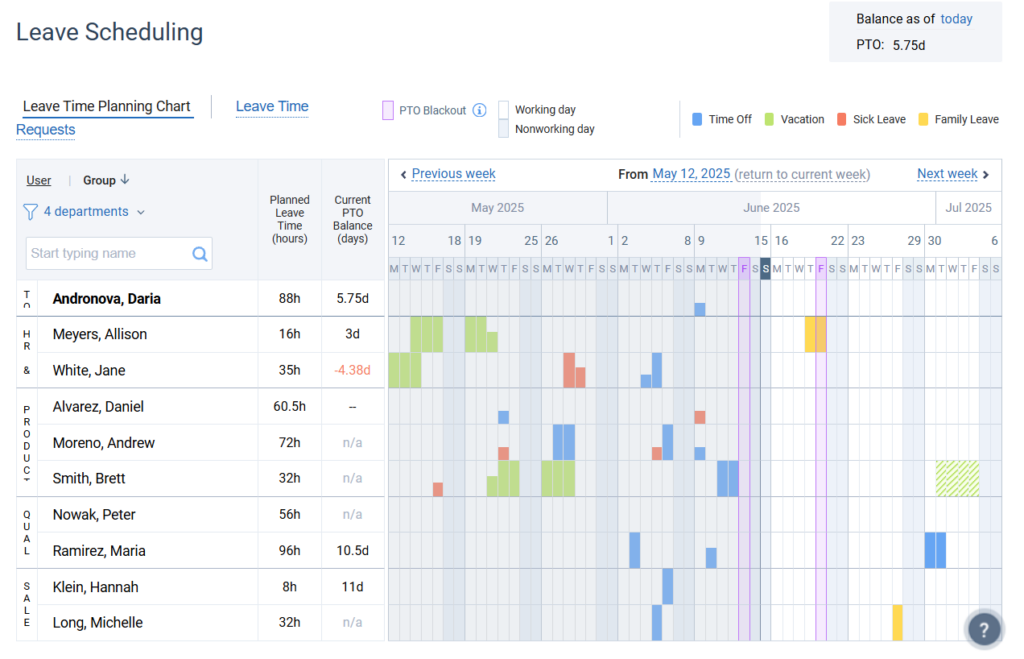
- Overlapping leave prevention stops two people from the same crew being off on the same day.
- PTO blackout dates block requests in critical periods such as holiday weeks or planned maintenance. See our guide to PTO blackout periods.
- Accrual runs automatically with configurable rules, caps and yearly resets, and every balance change is kept in its history.
- Leave types are unlimited, so sick leave, vacation and training can follow different approval rules.
- Location tracking shows who works at which site when crews cover several locations.
- Reports on leave time, balances and past leaves can be filtered by team and exported to CSV or PDF for payroll.
actiPLANS handles the leave and availability side of a Pitman roster; it does not replace your payroll system’s overtime calculation. Plans start at $1.50 per user per month billed annually, and the 30 day trial includes every feature. Start a free trial to set up your crews and leave rules.
FAQ
What is a typical 12 hour shift schedule?
The most common 12 hour patterns for 24/7 coverage are the Pitman (2-2-3) schedule, the DuPont schedule and the 4 on, 4 off schedule. All three use four crews and average 42 hours a week. They differ in block length: Pitman never runs more than 3 shifts in a row, DuPont runs up to 4 and then gives 7 days off, and 4 on, 4 off runs on an 8 day cycle that does not line up with the calendar week.
What is a 4-3-3-4 shift schedule?
The label is used for the DuPont 12 hour rotation, a 28 day cycle in which four crews cover a 24/7 operation. It is not the Pitman schedule: DuPont has longer work blocks and one full week off per cycle (see our DuPont schedule guide). Usage varies between employers, so confirm the exact sequence of work and rest days before comparing offers or rosters.
Is a 7 to 3:30 shift better than a Pitman schedule?
Different jobs. A 7:00 to 3:30 shift is an 8 hour day with a 30 minute meal break that fits a five day, 40 hour week on daytime operations. The Pitman schedule exists for operations that must be staffed day and night, and it trades longer shifts for half the year off. If your operation does not need 24 hour coverage, an 8 hour first shift is simpler to run.


