
Most construction scheduling software is built to schedule activities: pour the slab, then frame the second floor before the weather turns. Far fewer tools know whether the framing crew will turn up. A critical path that assumes eight carpenters on Monday falls apart when three of them had vacation approved by text message a month earlier.
This guide compares seven construction scheduling tools across both halves of that problem. Some are CPM and Gantt schedulers that sequence the work. Others schedule the people, crews, equipment, leave and job sites behind it. You’ll find pricing taken from each vendor’s own pages, a second table on what each tool really schedules, a worked example that shows how approved leave shrinks a three week lookahead, and the failure modes that break construction schedules in practice.
- What construction scheduling software does
- Construction scheduling software compared
- 7 construction scheduling tools reviewed
- What each tool actually schedules
- Worked example: what approved leave does to a lookahead
- How to choose construction scheduling software
- Where construction schedules break
- Best pick by situation
- FAQ
What construction scheduling software does
Construction scheduling software plans when each part of a build happens and who does it. It sequences activities with dependencies and a critical path, and it assigns crews, equipment and job sites to those activities by day. Most products are strong on one of those two jobs and thin on the other.
A construction job runs on two schedules at once. The first is the activity schedule, often called the construction project schedule or construction timeline: activities, durations, dependencies, the critical path and a baseline you measure delays against. On larger jobs this schedule is a contract document. The second is the people schedule: which crew works on which site each day, who is on leave, who holds the ticket for the excavator, and which machine is free.
Construction scheduling software falls into four groups, depending on which of the two schedules it handles:
- CPM schedulers, such as Oracle Primavera P6, built for the master schedule with critical path logic, baselines and resource loading.
- Construction management platforms, such as Procore and Buildertrend, which put the schedule next to drawings, budgets, change orders and client communication.
- Field task tools, such as Fieldwire, which turn the schedule into daily tasks for foremen and trades.
- Crew and resource schedulers, such as Assignar, Pro Crew Schedule and actiPLANS, which decide who and what goes to each job site.
In practice the two often live in different tools. A general contractor might keep the contractual schedule in P6 and run crews from a separate board, while a small remodeler might do everything in one platform. If daily dispatch of crews is your main job, our roundup of crew scheduling software goes deeper on that category.
Construction scheduling software compared
Here is how the seven construction schedule software options compare on audience and price. Pricing comes from each vendor’s own pricing page, and where a vendor does not publish a price, the table says so.
| Tool | Type and best for | Pricing |
|---|---|---|
| actiPLANS | Crew availability, leave and job site scheduling; teams that need to know who is available before they assign work | Free for up to 3 users; $1.50 per user per month billed annually for 1 to 40 users; $1.20 for 41 to 200 users |
| Oracle Primavera P6 EPPM | CPM scheduler; contractual master schedules on large programs | Not published |
| Procore | Construction management platform with a separate Resource Planning product; general contractors | Not published; annual fee based on annual construction volume, unlimited users |
| Buildertrend | Construction management platform; residential builders and remodelers | Not published; custom quote, unlimited users |
| Fieldwire | Field task scheduling; foremen and specialty contractors | Free plan for 5 users and 3 projects; paid plans from $39 per user per month billed annually |
| Assignar | Crew, operator and equipment scheduling; civil and heavy contractors with their own crews and plant | Not published |
| Pro Crew Schedule | Crew scheduling with time off requests; subcontractors | $9.99 per user per month on the Start Up tier (up to 100 users) |
7 construction scheduling tools reviewed
1. actiPLANS
actiPLANS is a leave management and availability tool, and it does not pretend to be a CPM scheduler. It’s for superintendents, operations managers and HR teams who need to know who is available, and where, before they assign anyone.
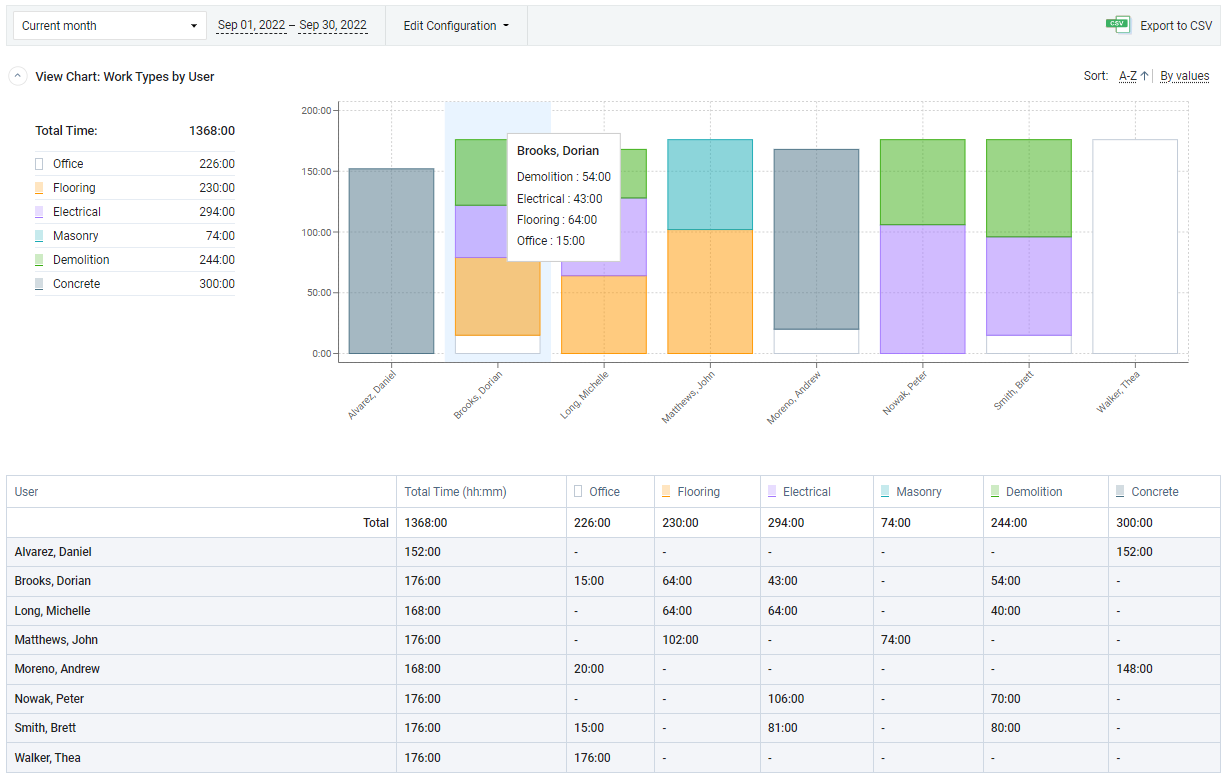
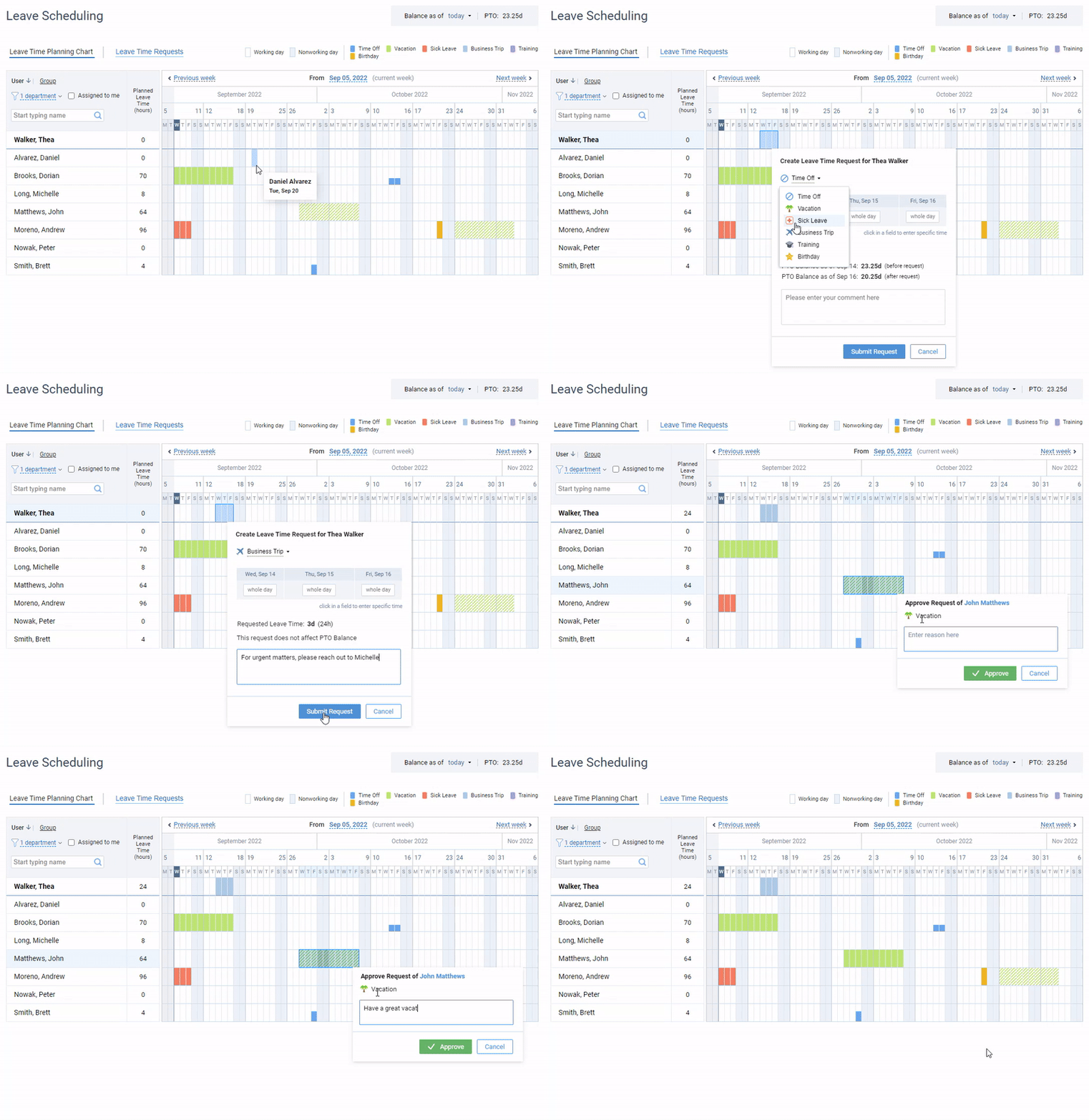
Scheduling runs on a visual timeline whose name you can change to suit your business (the default is Locations). You create custom types such as job sites, trades or shifts, give each a color, and assign them to people by day with a set number of hours. According to the actiPLANS user guide, dates turn gray for weekends, holidays and scheduled absences, and a gray dot marks any day where scheduled hours exceed the standard workday. Leave requests go through approval workflows with PTO accrual, blackout dates and overlapping leave prevention, so the gaps on the timeline reflect approved decisions. Crew members request leave or report that they are coming in late from the iOS and Android app, and email notifications tell them when their schedule changes. Work scheduling is part of the paid plans, not the free version.
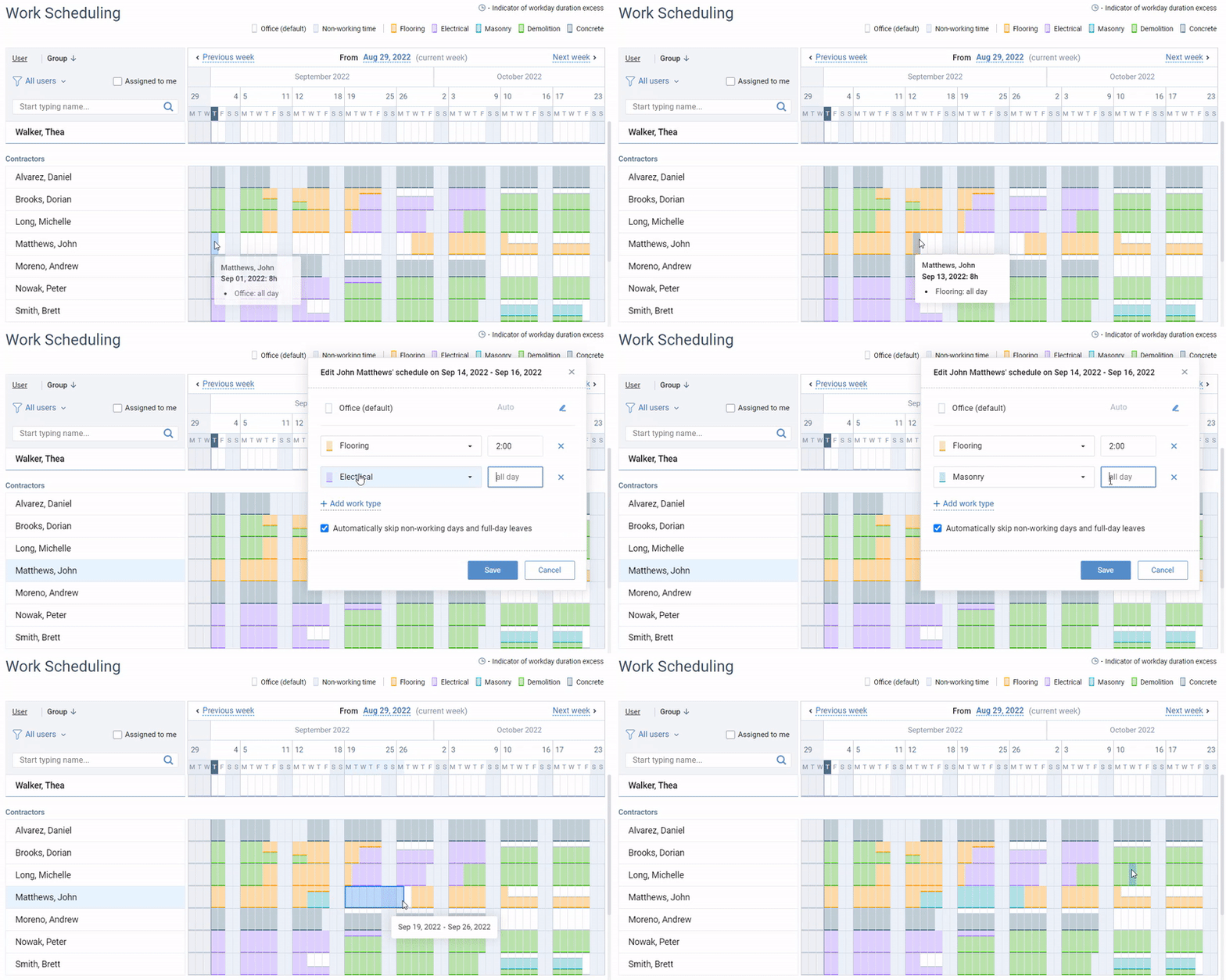
Limitation: there are no task dependencies, critical path, baselines or equipment scheduling. Use it next to a CPM or field task tool, not instead of one. Teams that also need hours by task can connect it to actiTIME.
Easy-to-use interface, accurate data, and reports. Automatic leave requests and approval really save a great deal of time.
2. Oracle Primavera P6
Oracle Primavera P6 EPPM is the scheduler that owners often name in the contract. It’s made for professional schedulers on large programs, such as infrastructure, industrial and commercial builds, where the schedule is a contract document and delay claims are argued from it.
Its core is critical path method (CPM) scheduling with secure multiuser access, so several schedulers can open and schedule many projects at once. Oracle lists role and resource optimization, demand and capacity planning, scenario analysis and graphical views of resource utilization, plus team member interfaces for collecting status updates. Combined with Primavera Unifier, P6 links schedule activities to cost codes, so cash flow curves and the cost of a proposed change come from the same logic as the dates. Oracle now offers Primavera Cloud as the migration path for P6 customers, with CPM scheduling and task management in one cloud environment.
Limitation: P6 assumes a trained scheduler at the keyboard. Crew availability exists only as data the scheduler enters and keeps current, and there is no leave request or approval workflow, so absences reach the schedule late or not at all. Oracle does not publish a price on its product page, so plan for a quote plus licenses and training.
3. Procore
Procore is a construction management platform for general contractors running many projects with many stakeholders. Scheduling sits next to drawings, RFIs, submittals, budgets and change orders, and that combination is the main reason companies buy it.
People scheduling comes from a separate product, Procore Resource Planning. It calculates a worker’s availability across their full workload rather than one assignment at a time, and it tracks certifications, skill sets and background checks for the workforce. A daily dispatch view lets you adjust crew and equipment assignments, and the product runs in a browser on desktop, tablet or phone, with a LaborChart mobile app for iOS and Android. That makes it one of the few platforms here that schedules people and equipment with the same tool.
Pricing works differently from the rest of this list. According to its pricing page, Procore charges an upfront annual fee by product, based on annual construction volume, and every contract includes unlimited users. For a contractor with large field and subcontractor teams, that removes the per seat math.
Limitation: there is no list price, and the cost grows with construction volume rather than headcount. Resource Planning is a separate product from the project schedule, so check which modules your quote includes.
4. Buildertrend
Buildertrend is built for home builders, remodelers and specialty contractors. Its pricing page says it suits builders who run five or more projects a year or complex builds with several phases.
The schedule is more detailed than most residential tools. The help center documents finish-to-start and start-to-start predecessors, created by dragging between items in the Gantt view, plus lag and lead time: for example, a two day lag between pouring concrete and starting framing. You can set a baseline that captures the original timeline, define default workdays and workday exceptions, and import a schedule from a template. An online and offline mode lets you build the schedule privately and then publish it. Once it’s online, trades and clients see their items, notifications go out and schedule conflicts go live. Every later change prompts for a shift reason and notes, which gives you a record when a homeowner asks why the cabinets moved. The mobile app creates and edits schedules too.
Limitation: the help article documents only those two link types, and the schedule tracks items and assigned users rather than leave or availability. Pricing is by custom quote, with 10% off when you pay for a year upfront.
5. Fieldwire
Fieldwire by Hilti schedules work at foreman level: tasks by trade, location and priority, shown as a Kanban board, a Gantt chart or a calendar. It suits specialty contractors and field teams who run pull planning and three week lookahead meetings.
The most useful detail for crew planning is manpower. You add a manpower figure to each task, and the graph at the top of the Gantt view adds it up for every day in view, so you can see how many workers a date needs. Schedules kept in Primavera P6, Microsoft Project or Excel come in through a spreadsheet import, and a Shift Dates action moves a group of tasks forward or back by a set number of days. You can export the Gantt view as a PDF lookahead, though the chart displays 200 tasks at a time, according to Fieldwire’s help center. The free Basic plan includes 100 sheets on top of its user and project limits, enough to test it on one live job.
Limitation: manpower is a number on a task, not a named person with a leave calendar. Fieldwire can tell you that Tuesday needs eight electricians, but it can’t tell you which eight are available.
6. Assignar
Assignar is for subcontractors and contractors who do the work with their own crews and plant: civil and earthworks, crane and lifting, traffic management, utilities, rail, and asphalt and paving. It schedules workers, operators, crews, machines and vehicles on one board.
Two things set it apart. First, compliance is part of scheduling. Assignar knows who is qualified, ticketed and inducted, and flags anyone who isn’t before they are booked. You can also set your own rest periods and hour limits, and the scheduler flags a fatigue breach before the shift starts. Second, the schedule is tied to the bid. Crews and plant are planned on the job’s own bid lines, crews confirm hours, plant time and quantities on iOS or Android, and those figures feed pay rules, job costing and invoices. Equipment can be booked without an operator for dry hire, and planning runs from next week to six or twelve months out.
Limitation: Assignar does not publish prices, so you need a demo to get a quote. It schedules crews and plant rather than CPM activities, so the master schedule still lives somewhere else.
7. Pro Crew Schedule
Pro Crew Schedule was built by subcontractors for subcontractors, with dedicated pages for HVAC, electrical, plumbing, concrete, roofing, painting and landscaping contractors. It’s the tool on this list that treats time off most like actiPLANS does, which makes the comparison useful.
It supports company wide crew based scheduling and employee based scheduling, with mobile access, digital time cards, document storage and an inventory module. Time off requests live in the same system, and the checks run in both directions. If an employee requests a day on which they already have a task, the system prompts them to choose a different day or to request that the scheduling administrator move the job. If an administrator tries to schedule a task on a day the employee has already filed for time off, the system returns an error. Apprentices’ work and school schedules can be managed in the same place, and the 30 day trial needs no credit card.
Limitation: its pages don’t document CPM features such as a critical path or baselines, and companies with more than 100 users have to request corporate pricing.
What each tool actually schedules
The first table separates tools by price and audience. This one separates them by the thing that decides the purchase: whether the tool sequences the work, schedules the people, or both. Entries come from each vendor’s product pages and help documentation.
| Tool | Activity logic (CPM, Gantt, dependencies) | Crew availability, leave and field access |
|---|---|---|
| actiPLANS | None; a day by day timeline of job sites, trades or shifts per person | Leave requests and approvals, PTO accrual, blackout dates, overlap prevention; mobile app for leave requests and team absences |
| Oracle Primavera P6 | CPM scheduling, multiuser, resource and role optimization, scenario analysis | Availability entered by the scheduler; no leave workflow; status updates through team member interfaces |
| Procore | Project schedule inside the platform; Resource Planning sold as a separate product | Availability across full workload, certifications, crew and equipment dispatch; browser and LaborChart mobile app |
| Buildertrend | Gantt with finish-to-start and start-to-start links, lag and lead, baseline, workday exceptions | Notifications to assigned users, trades and clients; mobile schedule editing; no leave workflow in the schedule documentation |
| Fieldwire | Kanban, Gantt and calendar; daily manpower totals; imports from P6, Microsoft Project and Excel | Tasks by trade and foreman on mobile; no named availability or leave |
| Assignar | Not documented; planning horizon from one week to 6 or 12 months | Crews, operators and plant with qualification and fatigue checks; crews confirm shifts on mobile |
| Pro Crew Schedule | Task scheduling for crews and employees; CPM not documented | Time off requests that block conflicting tasks; mobile access and digital time cards |
Read across the rows and a pattern shows. The tools with the deepest activity logic know the least about individual people, and the tools that track named people and their leave don’t sequence activities. That’s why most contractors above a handful of crews end up with two systems, and why the handoff between them is where schedules break.
Worked example: what approved leave does to a lookahead
The figures below are illustrative. A framing subcontractor builds a three week lookahead for a crew of eight carpenters. The activity schedule says floors two and three need 112 crew days of framing in that window.
| Input | Value | How it’s calculated |
|---|---|---|
| Crew size | 8 carpenters | Given |
| Lookahead window | 15 working days | 3 weeks × 5 days |
| Gross capacity | 120 crew days | 8 × 15 |
| Work required | 112 crew days | From the activity schedule |
| Approved vacation | 15 crew days | 3 carpenters × 5 days each |
| Available capacity | 105 crew days | 120 − 15 |
| Shortfall | 7 crew days (56 hours) | 112 − 105; 7 × 8 hours |
| Finish date impact if leave is spread out | About 1 working day late | 7 ÷ 8 = 0.9 days |
On paper, the leave costs less than a day. Now move all three vacations into the same week. Total capacity is unchanged, but that week runs with five carpenters out of eight, 62.5% of the crew. If setting the trusses needs at least six people for safe lifting, the critical activity stops for the whole week, and the finish slips by up to five working days instead of one. Clustering does more damage than volume, and a CPM schedule that holds crew size as a single number never sees it.
Leave isn’t an edge case. In US private industry, 77% of workers in construction, extraction, farming, fishing and forestry occupations had access to paid vacation in 2026, and 71% had paid sick leave, according to BLS Table 6. US federal law does not require paid vacation, as the Department of Labor notes, so the amount depends on each employer’s policy. In the UK, workers on a five day week are entitled to 28 days of paid annual leave, and employers may count bank holidays within it (GOV.UK). In Canada, federally regulated employers must give two weeks after one year, three after five years and four after ten (Canada.ca), while provinces set the rules for most other employers. Even if a UK employer counts England’s 8 bank holidays within the 28 days, an eight person crew still has 160 days of leave to place across the year (8 × 20).
How to choose construction scheduling software
Before you buy scheduling software for construction, decide which schedule is failing you. If dates slip because the sequence is wrong, you need activity logic. If dates slip because the right people aren’t on site, you need a people schedule. Then test each shortlisted tool against the criteria below.
Activity logic
Check which dependency types the tool supports (finish-to-start, start-to-start and others), whether it calculates a critical path, whether you can set a baseline and compare updates against it, and whether it imports and exports the formats your owners and general contractors use. If the contract names a scheduling tool or file format, that requirement decides the shortlist before anything else.
Crew availability and leave
Ask whether the tool knows named people or only headcount, whether leave goes through an approval workflow, and whether conflicts are blocked in both directions: a leave request against assigned work, and an assignment against approved leave. A shared, visible leave process is half the fix; our guide to leave request management covers how to set one up.
Resource planning: labor, equipment and materials
Construction resource management and resource planning cover more than people. Check whether the tool schedules equipment with or without an operator, tracks certifications and inductions, and ties scheduled hours to job costing. Assignar and Procore Resource Planning schedule crews and equipment together, and Pro Crew Schedule adds an inventory module for materials. Float, a general resource scheduler, also turns up on construction shortlists. It plans people by hours or by percentage of capacity, handles time off, and bills only for people on the schedule, while everyone else joins as a free guest. Its pricing page says nothing about equipment or site compliance. Planning by job site also matters for companies running several sites at once; location scheduling in actiPLANS shows who works where on each day.
Integrations
Think about where the schedule’s data goes once it’s built. Payroll and job costing are the usual stops: Assignar sends verified invoices, supplier bills and payroll summaries to Xero, MYOB or a construction ERP, and actiPLANS connects to actiTIME when you need hours by task. Getting an existing schedule in matters just as much, and Fieldwire imports task lists exported from Primavera P6, Microsoft Project or Excel. For calendars, actiPLANS publishes iCal feeds so leave and schedules show up in Google Calendar or Outlook. When a tool can’t connect to any of these, someone ends up retyping dates and hours by hand, usually late on a Friday.
Field access
If crews never open the app, the schedule only exists in the office. Check what the mobile app lets a crew member do: see assignments, confirm shifts, request leave, report a late start. Then check what notifications go out when a date moves.
Pricing model
The seven tools use four pricing models: per user (actiPLANS, Fieldwire, Pro Crew Schedule), a custom quote with unlimited users (Buildertrend), an annual fee based on construction volume with unlimited users (Procore), and quotes with no published basis (Primavera P6, Assignar). Per user pricing favors small office teams; unlimited user pricing favors companies that want every subcontractor and field worker in the system.
Where construction schedules break
Software choice matters less than you’d think for most of these. They come from how the schedule is run.
- Leave approved outside the schedule. A foreman says yes to a week off by text, and the scheduler finds out on Monday morning. The fix is one approval workflow that the scheduler can see, with absence management rules everyone follows.
- Two systems with no owner of the handoff. The master schedule lives in a CPM tool, the crew board in a spreadsheet, and nobody reconciles them. Name one person who checks crew availability against the lookahead every week.
- External constraints forced into fake dates. Work that waits on weather or river levels gets an arbitrary start date, and the logic breaks when reality differs. A driving milestone such as “low flow reached”, with the tasks that follow linked to it, keeps the logic intact and documents the delay.
- A detailed schedule in a business that changes by ten in the morning. Small contractors whose priorities shift daily often get more from a short lookahead and a visible daily board than from a full CPM model nobody updates.
- The wrong person on the job. Expired tickets and missing inductions get caught at the gate, or after an incident. Qualification checks at the moment of booking prevent both.
- Hidden overload. Ten hour days stack up without anyone noticing until fatigue or overtime costs show up. A tool that flags days above the standard workday makes the problem visible before payroll does.
Best pick by situation
- If the contract requires a CPM schedule on a large program, use Oracle Primavera P6 and keep crews and leave in a separate tool.
- A general contractor that wants documents, schedule and crews in one platform should look at Procore, and make sure Resource Planning is in the quote.
- Residential builders and remodelers juggling several jobs and client updates will get the most from Buildertrend.
- When foremen need daily tasks and lookaheads on site, Fieldwire fits, and the free plan is enough for a first job.
- Civil and heavy contractors booking operators and machines with compliance checks should shortlist Assignar.
- A trade subcontractor that wants crew scheduling and time off in one low cost system can start with Pro Crew Schedule.
- If your schedules break because people are away when you didn’t expect it, add actiPLANS next to your activity schedule so everyone can see who is available and on which site.
FAQ
What software does a construction project manager use?
Most construction project managers use a CPM or Gantt scheduler for the activity schedule, often Primavera P6 or Microsoft Project on larger jobs, and a construction management platform such as Procore or Buildertrend for documents and coordination. Many add a separate tool for crew availability and leave, because neither of the first two tracks named people well.
How much does construction scheduling software cost?
It depends on the pricing model more than the feature list. Per user tools range from free plans for a few users to around $39 per user per month for field task software, while platforms such as Procore and Buildertrend quote a company price with unlimited users. Procore bases its annual fee on construction volume, so a builder with $5 million of annual construction volume should expect a lower quote than one with $100 million.
Is there free construction scheduling software?
Yes, with limits. Fieldwire’s free plan covers 5 users and 3 projects, and actiPLANS is free for up to 3 users, though work scheduling needs a paid plan. A free plan works for testing a tool on one job; a full crew usually needs a paid tier.
What is the difference between construction scheduling and construction employee scheduling software?
Construction scheduling software sequences activities: what happens in what order and how long it takes. Construction employee scheduling software assigns named people to shifts, sites and tasks and tracks their availability and leave. Large jobs need both, and the tools rarely do both well.
Can you build a construction schedule in Excel?
For a single small job, yes. The catch is that Excel has no scheduling engine: if one activity slips, the ones after it stay put unless you’ve built the formulas yourself, and nobody gets told. Teams that outgrow it often move to Smartsheet, whose Pro plan has a Gantt view and dependencies for 1 to 10 members, or to one of the tools above.


