
Employee scheduling software replaces the spreadsheets, group chats, and shift swap texts that eat up management time every week. Some tools are built around shift rotation for hourly workers. Others focus on leave management and availability tracking for salaried or hybrid teams. A few try to do everything at once, with mixed results.
We compared 10 employee scheduling tools by features, pricing, and team fit. The list includes shift platforms built for restaurants and retail, leave managers designed for office and remote teams, and a couple of broader platforms that bundle scheduling with communication or HR. Each entry notes what the tool does well and where it runs out of depth.
Employee scheduling software comparison
| Tool | Best for | Free plan | Starting price |
|---|---|---|---|
| actiPLANS | Leave and availability management | Yes (up to 3 users) | $1.50/user/month |
| Connecteam | Deskless and frontline teams | Yes (up to 10 users) | $29/month (30 users) |
| Deputy | Labor compliance and forecasting | No | $5/user/month |
| 7shifts | Restaurants | Yes (1 location, 15 employees) | $39.99 CAD/month per location |
| Homebase | Small businesses with hourly staff | Yes (1 location, 10 employees) | $30/month per location |
| When I Work | Simple shift scheduling | No | $2.50/user/month |
| Sling | Teams on a tight budget | Yes (up to 30 users) | $2/user/month |
| Findmyshift | Complex shift patterns | Yes (up to 5 members) | €24/team/month |
| Planday | Multi-location shift businesses | No | From £2.99/user/month |
| Agendrix | Canadian businesses | No | $3.25 CAD/user/month |
10 best employee scheduling software tools
1. actiPLANS
- Leave management with automated PTO accrual
- Work location scheduling (office, remote, field)
- Visual team availability timeline
- Approval workflows and PTO blackout dates
actiPLANS approaches employee scheduling from the availability side rather than the shift side. Instead of building schedules shift by shift, you set up who is available when, where they are working from, and which leave types your organization uses. The system then handles PTO accrual calculations, leave request approvals, and balance tracking automatically.
The visual timeline is the standout. Managers see the entire team’s schedule, leave status, and location on one screen, which makes it easy to spot overlapping absences before approving a new request. You can set PTO blackout dates for busy periods and configure overlap prevention rules so critical roles stay covered.
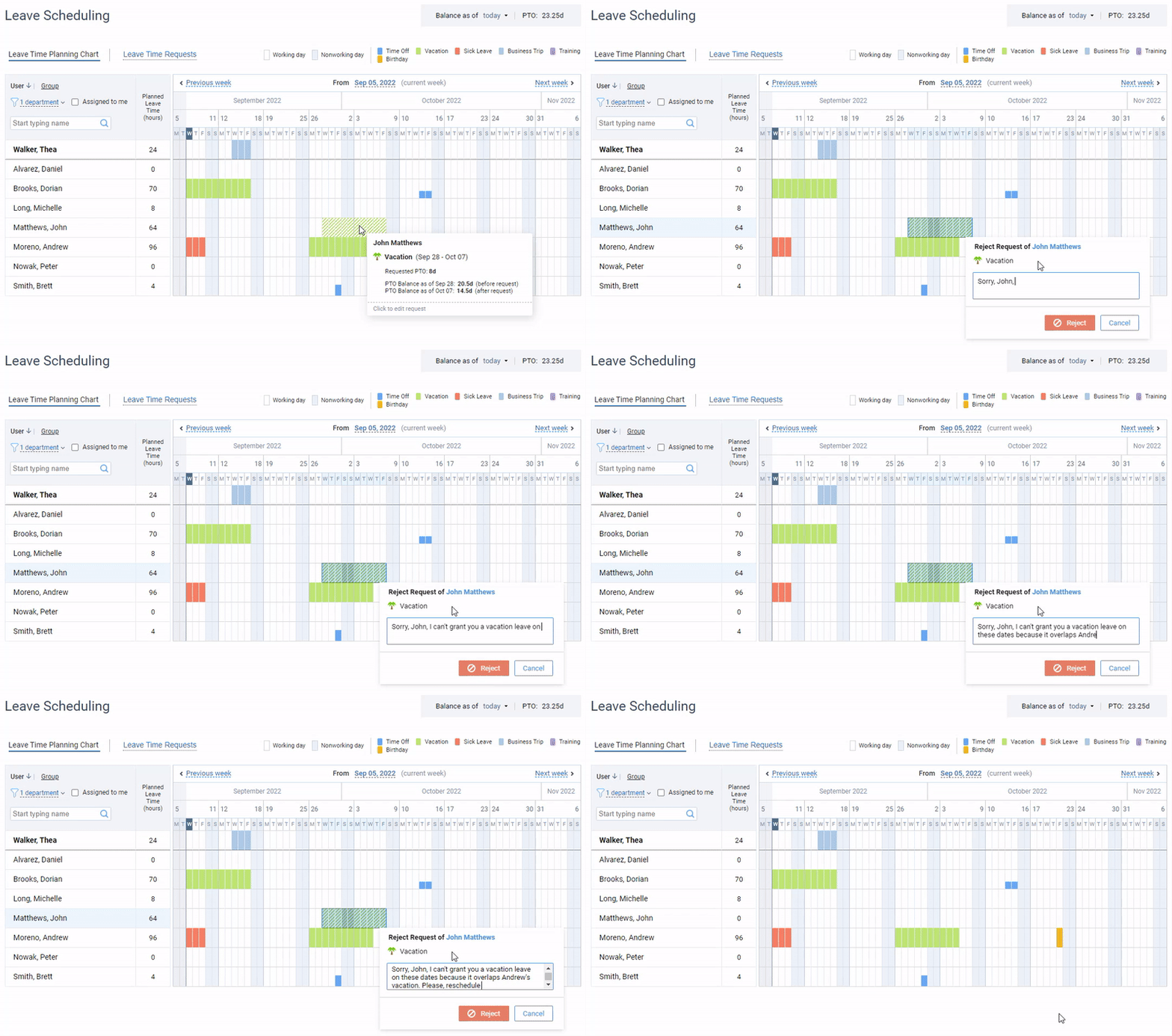
PTO accrual runs on configurable rules: weekly, biweekly, monthly, or custom schedules with caps and yearly resets. Employees can check their own balances and request time off from the mobile app without pinging a manager. When a request comes in, managers can approve, reject, or bulk approve in a few clicks.
actiPLANS integrates with actiTIME for teams that need time tracking alongside absence management, and exports all leave data to CSV or PDF for payroll.
Price: Free for up to 3 users. Paid plans start at $1.50 per user per month (billed annually). 30-day free trial with full features.
Capterra rating: 4.6 (13 reviews)
Best for: Teams that need leave management, PTO tracking, and availability scheduling more than shift rotation. Works well for office, hybrid, and remote teams across consulting, IT, healthcare, and professional services.
2. Connecteam
- Shift scheduling with drag and drop
- GPS time clock and geofencing
- In app communication and training
- Task management and checklists
Connecteam bundles scheduling, communication, time tracking, and HR tools into one platform built for teams that work away from a desk. Field service crews, retail staff, and construction teams get a single app instead of juggling three or four separate tools.
The scheduling module lets managers create shifts using drag and drop, copy recurring schedules, and set up auto assignment based on employee qualifications and availability. When someone cannot make a shift, they can offer it for swap or drop it for others to claim. The GPS time clock tracks where employees clock in and out, and geofencing prevents punches from unauthorized locations.
Beyond scheduling, Connecteam includes a communication hub with announcements, group chats, and a company knowledge base. The training module lets you build courses and quizzes employees complete on their phones. That breadth saves teams from juggling multiple apps, though no single module goes as deep as a tool built for just that one job. If all you need is scheduling, Connecteam is more platform than you bargained for.
Price: Free for small businesses (up to 10 users). Paid plans start at $29 per month for up to 30 users (Operations hub, billed annually). 14-day free trial.
Capterra rating: 4.6 (5,322 reviews)
Best for: Deskless and frontline teams in construction, field services, retail, and cleaning who want scheduling, communication, and time tracking in one app.
3. Deputy
- AI powered auto scheduling
- Demand forecasting and labor budgeting
- Compliance management with break and overtime alerts
- POS and payroll integrations
Deputy focuses on the compliance and cost side of employee scheduling. Its auto scheduling engine considers employee availability, skills, labor costs, and local labor law requirements to generate schedules that stay within budget and legal limits. Managers can review and adjust the generated schedule before publishing.
The demand forecasting feature uses historical sales data and foot traffic patterns to predict staffing needs. Deputy connects to popular POS systems like Square and Lightspeed, pulling in revenue data to calculate labor cost as a percentage of sales in real time. When labor cost creeps over budget, the system flags it before the week closes.
Compliance alerts are where Deputy earns its keep for businesses in heavily regulated industries. The system tracks break requirements, maximum shift lengths, overtime thresholds, and predictive scheduling laws by jurisdiction. If a schedule violates a rule, Deputy blocks it or warns the manager before it goes out. This matters most in states like California, Oregon, and New York that enforce strict scheduling regulations.
Price: Starting from $5 per user per month (Lite plan). No free plan. Minimum $30 per month per invoice.
Capterra rating: 4.6 (775 reviews)
Best for: Shift heavy businesses in retail, hospitality, and healthcare that need labor cost controls and labor law compliance built into the scheduling workflow.
4. 7shifts
- Restaurant specific scheduling
- POS integration for labor cost tracking
- Tip pooling and management
- Team communication and manager log book
7shifts is built specifically for restaurants and food service businesses. Every feature, from schedule templates to labor cost reports, is designed around how restaurants actually operate: variable demand across meal periods, tipped employees, front and back of house roles, and high turnover.
The scheduling engine factors in employee availability, overtime rules, and labor targets to build weekly schedules. Managers can set labor budget targets by day or by meal period, and the system warns when a draft schedule runs over. The POS integration (Toast, Square, Clover, and others) pulls in actual sales data so managers can compare projected labor cost against revenue as the week progresses.
7shifts also includes tip pooling and distribution, a manager log book for shift handoff notes, and a hiring module. The mobile app lets employees swap shifts, pick up open shifts, and request time off. For a single location restaurant, the free plan covers basic scheduling for up to 15 employees, which is a low risk way for a small restaurant to test whether dedicated scheduling software is worth it.
Price: Free for 1 location (up to 15 employees). Paid plans start at $39.99 CAD per month per location (Essentials). Free trial available.
Capterra rating: 4.7 (1,212 reviews)
Best for: Restaurants, bars, cafes, and food service businesses that want scheduling tied directly to POS data and labor cost tracking.
5. Homebase
- Scheduling, time clock, and hiring in one platform
- Built in payroll (add on)
- Team messaging
- Labor cost tracking and overtime alerts
Homebase targets small businesses with hourly employees: restaurants, retail shops, salons, and service providers. The free plan covers scheduling, time tracking, and messaging for one location with up to 10 employees, which makes it a practical starting point for owner operators who cannot justify a monthly subscription.
Schedules are built on a drag and drop grid by day and role. Homebase auto populates based on employee availability and sends shift reminders via push notification or text. The time clock works on a shared tablet, phone, or computer, and tracks breaks and overtime automatically. At the end of the pay period, managers export timesheets directly to payroll providers like Gusto, QuickBooks, and ADP, or use Homebase’s own payroll add on.
The hiring module posts open positions to job boards and lets applicants apply through a mobile form. This is a useful extra for businesses with high turnover, though the feature is more basic than a dedicated applicant tracking system. Where Homebase falls short is scale: the per location pricing model gets expensive for businesses with many locations.
Price: Free for 1 location (up to 10 employees). Paid plans start at $30 per location per month (Essentials). 14-day free trial of the top tier plan.
Capterra rating: 4.6 (1,157 reviews)
Best for: Small businesses with hourly employees at one or two locations who want scheduling, time tracking, and basic hiring tools without a large monthly spend.
6. When I Work
- Simple shift scheduling interface
- Auto scheduling based on availability
- Shift swapping and open shift claims
- Payroll and POS integrations
When I Work keeps things simple. The interface is clean and focused: you build a schedule, employees get notified, and they can swap or pick up shifts from their phones. There is no project management layer, no learning module, no HR suite attached. For teams that want shift scheduling and nothing else, that simplicity is the selling point.
The auto scheduling feature generates a draft schedule based on employee availability, preferred hours, and any roles or skills you have assigned. Managers review, adjust, and publish with one click. Once published, employees receive push notifications. Shift swaps go through manager approval by default, though you can allow direct swaps between qualified team members.
When I Work integrates with payroll providers (ADP, Gusto, QuickBooks) and POS systems so time data flows into payroll without manual export. The scheduling rules engine lets you set maximum hours, overtime warnings, and minimum rest periods between shifts. It does not include labor cost forecasting or compliance alerts as deep as Deputy, but for teams that prioritize ease of use over advanced analytics, it handles the fundamentals well.
Price: Starting from $2.50 per user per month (Essentials). No free plan. 14-day free trial, no credit card required.
Capterra rating: 4.5 (1,300+ reviews)
Best for: Teams that want a clean, focused shift scheduling tool without bundled HR or communication features. Works across retail, hospitality, healthcare, and warehousing.
7. Sling
- Free scheduling for up to 30 users
- Labor cost management
- Time off requests and availability tracking
- Internal messaging and newsfeed
Sling has a genuinely useful free tier. Up to 30 users get shift scheduling, time off requests, available shift posting, and internal messaging at no cost. Most free plans cap at 5 or 10 users, so 30 is unusual.
The paid tiers add time tracking with a clock in and clock out system, labor cost management tools, and PTO tracking. The Business plan ($4 per user per month) includes kiosk mode for shared tablet clocking, advanced reports, and overtime calculations. Sling also tracks labor cost per shift and per location, giving managers a running view of where payroll hours are going.
Where Sling has limits is in automation and integrations. There is no auto scheduling engine, so managers build every schedule manually. The integration list is shorter than Deputy or When I Work, which means more manual data transfer to payroll. If your main requirement is a scheduling tool that works today for nothing, Sling delivers. If you need automated scheduling or deep payroll integration, you will outgrow it, and probably sooner than you expect.
Price: Free for up to 30 users (basic features). Premium starts at $2 per user per month. 15-day free trial of paid features.
Capterra rating: 4.6
Best for: Budget conscious teams that need functional scheduling for free. Good for restaurants, retail, and small service businesses just starting to move off paper or spreadsheet schedules.
8. Findmyshift
- Drag and drop shift scheduling
- Payroll cost calculations
- Calendar and email integration
- Shift pattern templates
Findmyshift is a UK based scheduling platform that handles complex shift patterns well. The drag and drop schedule builder lets managers create, copy, and rotate shifts across days and weeks. You can set up recurring shift templates for teams that follow fixed rotation patterns, cutting the time spent rebuilding schedules every period.
Payroll calculations happen inside the scheduling view. Findmyshift tallies hours per employee, factors in overtime and pay rates, and shows labor cost per shift. The output exports to CSV for payroll processing. Calendar integration syncs published schedules to Google Calendar, Outlook, or any iCal compatible app, so employees see their upcoming shifts alongside personal appointments. The free plan covers teams of up to 5 members with a 1 week look back window, while the Enterprise plan supports 300 members with a 10 year archive. Where Findmyshift trails behind newer competitors is in mobile experience and automation: there is no auto scheduling, and the mobile interface is not as polished as Deputy or When I Work.
Price: Free for up to 5 team members. Paid plans start at €24 per team per month (Starter, up to 20 members). All features free for the first 3 months.
Capterra rating: 4.6 (1,204 reviews)
Best for: Teams with repeating shift patterns and part time or hourly staff. Solid choice for businesses in the UK and Europe that want no-frills scheduling without a steep learning curve.
9. Planday
- Shift planning with demand based scheduling
- Time clock with GPS tracking
- Revenue and labor cost integration
- Team messaging
Planday is a workforce management platform built for shift based industries like hospitality, retail, and healthcare. Managers create schedules based on demand, employee skills, contracted hours, and local labor rules. The platform factors in maximum working hours and mandatory rest periods to flag compliance issues before a schedule goes live.
Planday connects to POS and revenue systems (including Xero, QuickBooks, and several restaurant POS platforms) to overlay labor cost on revenue data. Managers see labor cost as a percentage of revenue per day or per shift, and can adjust staffing in real time to hit targets. The time clock supports GPS tracking and geofencing for employees who work at multiple locations.
The messaging feature keeps shift updates and schedule changes in one place, reducing the back and forth on personal messaging apps. Employees can view schedules, request time off, swap shifts, and clock in from the Planday mobile app. Planday was acquired by Xero in 2021, which tightened the payroll integration for businesses already using Xero for accounting.
Price: Starting from £2.99 per user per month (Starter). No free plan. 30-day free trial, no credit card required.
Capterra rating: 4.3 (58 reviews)
Best for: Shift based businesses in hospitality, retail, and healthcare, especially those with multiple locations or teams spread across different sites. Strong in the UK and European markets.
10. Agendrix
- Schedule creation with templates and auto fill
- Time and attendance tracking
- Internal messaging and announcements
- HR document management
Agendrix is a Canadian scheduling platform with a strong footprint in Quebec and across Canada. The platform covers scheduling, time tracking, communication, and basic HR document storage. Schedules are built from templates, and the auto fill function suggests employees based on availability, qualifications, and hour limits.
Managers can publish schedules to the mobile app with one click and track who has viewed them. Employees request time off, swap shifts, and mark availability from their phones. The time and attendance module tracks clock ins and calculates hours, overtime, and breaks. Agendrix also stores onboarding documents, policies, and HR files in a central location accessible from the app.
The internal messaging tool replaces group texts for schedule related communication. Managers send targeted announcements to specific teams, locations, or roles without cluttering a shared group chat.
For Canadian businesses, Agendrix handles bilingual scheduling (English and French) and aligns with provincial labor standards. The 21 day trial is longer than most competitors, giving teams enough time to run a full payroll cycle before committing.
Price: Starting from $3.25 CAD per user per month (Essential). No free plan. 21-day free trial, no credit card required.
Capterra rating: 4.8 (212 reviews)
Best for: Canadian businesses, particularly in retail, healthcare, and food service, that want scheduling, time tracking, and team communication with bilingual support and compliance with Canadian labor standards.
How to choose employee scheduling software
The first question is whether your team needs shift scheduling, leave and availability management, or both. Shift scheduling tools like 7shifts, Deputy, and When I Work build schedules around time slots and roles. Leave management tools like actiPLANS track who is available, who is off, and how PTO balances change over time. Some teams need both, but picking the right starting point avoids paying for features you will not use.
Team size and location count shape the pricing math. Per user pricing (Deputy at $5, When I Work at $2.50, Sling at $2) works well for smaller teams but adds up fast at 100+ employees. Per location pricing (Homebase at $30, 7shifts at roughly $29 USD) favors single location businesses but multiplies for chains. Flat rate plans like Connecteam’s $29 for 30 users or actiPLANS’s Enterprise at $270 per month for unlimited users can save money at scale.
If you already run operations through a CRM, project management tool, or payroll system, check whether the scheduling software connects to it. Tools like Deputy and Planday integrate with POS and accounting platforms. actiPLANS integrates with actiTIME for combined time tracking and leave management. A scheduling tool that does not connect to your existing stack creates extra manual work at the end of every pay period.
Finally, consider where your employees actually work. A restaurant with hourly staff needs GPS clocking and shift swap tools. A consulting firm with salaried employees needs PTO tracking and location scheduling. A retail chain with both hourly and salaried workers may need one tool for the store floor and another for the head office. Match the tool to the work, not the other way around.
FAQ
What is employee scheduling software?
Employee scheduling software automates the process of assigning employees to shifts, tracking availability, managing time off requests, and monitoring labor costs. It replaces manual methods like spreadsheets, paper schedules, and group messages with a centralized system where managers build schedules and employees view, swap, and request changes from a web or mobile app.
Does Google have an employee scheduling tool?
Google does not offer a dedicated employee scheduling product. Some small teams use Google Sheets or Google Calendar as a workaround, but these lack features like shift swapping, labor cost tracking, time off management, and compliance alerts. For teams beyond a handful of people, a purpose built scheduling tool saves time and reduces errors that spreadsheet based scheduling creates.
What is the best free employee scheduling software?
Sling offers the most generous free plan: up to 30 users with shift scheduling, time off requests, and internal messaging. Connecteam’s free plan covers up to 10 users with scheduling, time tracking, and communication. 7shifts is free for one restaurant location with up to 15 employees. actiPLANS is free for up to 3 users with leave management and location scheduling. The best free option depends on whether you need shift scheduling (Sling), an all in one platform (Connecteam), restaurant tools (7shifts), or leave management (actiPLANS).
How much does employee scheduling software cost?
Pricing ranges from free to around $10 per user per month for most small and mid sized teams. Per user plans typically start between $1.50 (actiPLANS) and $5 (Deputy) per user per month. Per location plans like Homebase and 7shifts start at $29 to $30 per month per location. Flat rate plans like Connecteam start at $29 per month for up to 30 users. Most tools offer a free trial between 14 and 30 days.
Can employee scheduling software integrate with payroll?
Most tools on this list integrate with at least one payroll provider. Deputy, Homebase, When I Work, and 7shifts connect to popular payroll services like ADP, Gusto, and QuickBooks. Planday integrates directly with Xero. actiPLANS exports leave and attendance data to CSV and PDF for payroll processing. The depth of integration varies: some tools push hours and overtime data directly, while others require a manual export step.
What is automated employee scheduling?
Automated employee scheduling uses software rules and algorithms to generate draft schedules based on employee availability, skills, labor budgets, and compliance requirements. Instead of building every shift from scratch, the system suggests an optimized schedule that the manager reviews and publishes. Deputy and When I Work offer auto scheduling. 7shifts uses labor budget targets to suggest staffing levels. Tools like Sling and Findmyshift require manual schedule building.
What features should I look for in scheduling software?
The features that matter most depend on your team type. Shift based teams need drag and drop scheduling, shift swapping, auto scheduling, and labor cost tracking. Leave focused teams need PTO accrual, approval workflows, and availability calendars. All teams benefit from mobile access, notifications, payroll export, and reporting. Regulated industries should look for compliance alerts that flag overtime, break, and scheduling law violations before a schedule goes live.
What is the best scheduling app for small businesses?
For small businesses with hourly employees, Homebase offers a strong free plan with scheduling, time tracking, and messaging for one location. Sling’s free plan supports up to 30 users. For small teams that need leave management rather than shift scheduling, actiPLANS is free for up to 3 users with full leave tracking and PTO accrual. The right choice depends on whether your team runs on shifts (Homebase, Sling) or manages availability and time off (actiPLANS).
Get scheduling wrong and payroll is off, labor runs over budget, and people stop trusting the calendar. None of these tools is universally best, which is why the comparison table at the top matters. Pick the one that fits your team type, run it through a full pay period on a free trial, and get your people to actually use it before you commit. A tool nobody opens is worse than the spreadsheet it replaced.
If your team needs leave management, PTO tracking, and location scheduling, start a free actiPLANS trial and see how it works with your workflow.


