Tracking attendance manually is manageable when your team has four people. Once you pass ten, a spreadsheet starts breaking. Someone forgets to log their hours, someone else edits the wrong cell, and the payroll numbers are off before you notice.
Attendance management software handles the repetitive parts: logging hours, calculating balances, routing leave requests, flagging exceptions. The result is fewer errors and less time spent on admin work that does not need a human brain behind it.
We compared 8 attendance management systems across pricing, features, and team size fit. Here is what each one does well and where it falls short.
Quick Comparison
| Software | Best for | Pricing |
|---|---|---|
| actiPLANS | Leave scheduling and PTO tracking | Free (3 users), from $1.50/user/mo |
| Rippling | Unified HR, IT, and payroll | From $8/user/mo |
| Factorial | SMBs needing full HR management | From $6.20/user/mo |
| Keka | Large teams with shift scheduling | From $5/user/mo (100-user minimum) |
| Eddy | Small business all-in-one HR | From $6/user/mo |
| ClockIt | Biometric time clock and geofencing | From $2.99/user/mo |
| All Hours | Remote and hybrid teams | From $3.50/user/mo |
| TimeClick | On-premise time clock (one-time purchase) | $249 to $999 (one-time) |
actiPLANS
actiPLANS is attendance management software built around leave scheduling and PTO tracking. Instead of clocking employees in and out, it focuses on managing who is available when. You schedule absences, track leave balances, and the whole team sees a shared availability view.
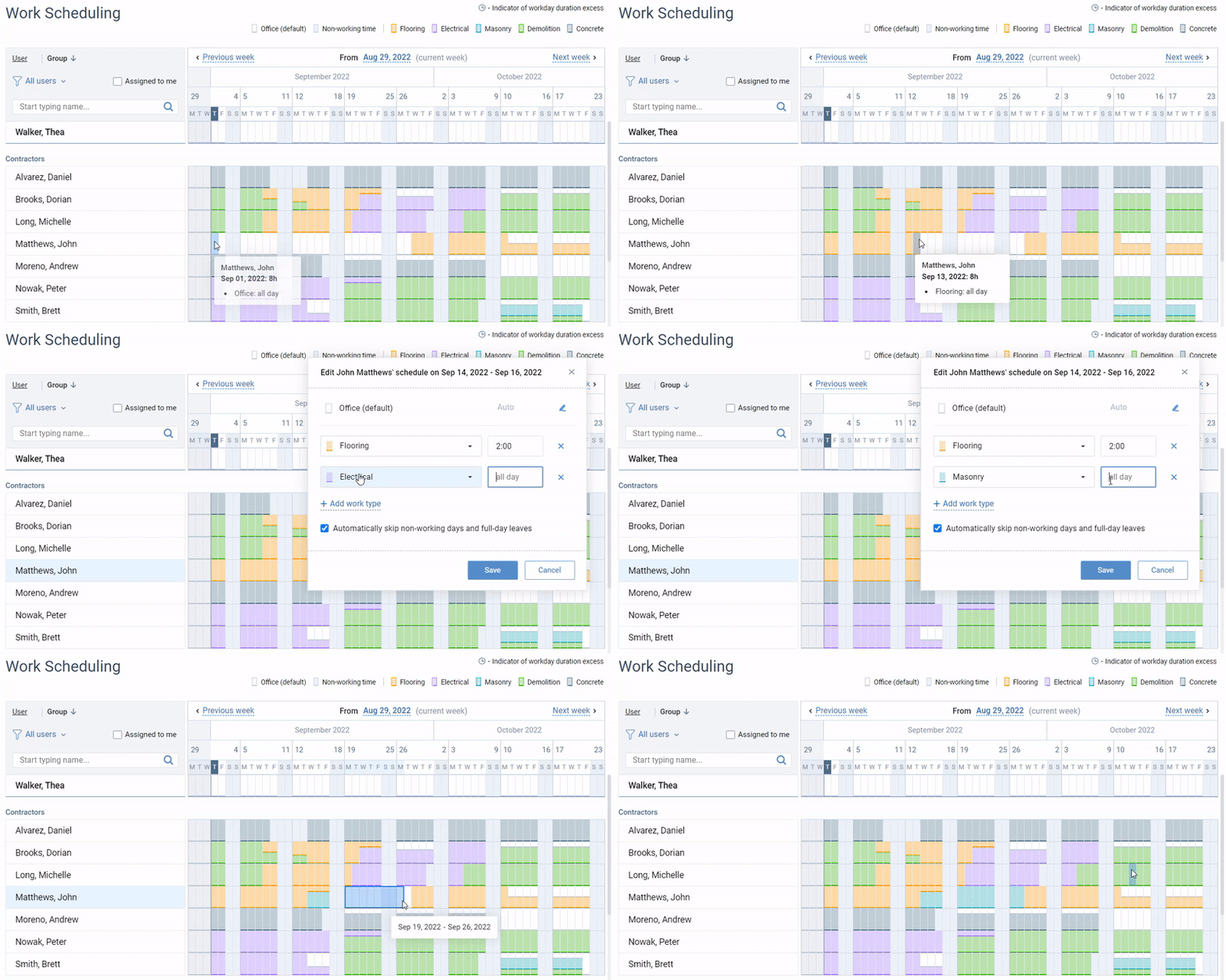
The visual timeline lets you schedule custom work types (shifts, project activities, locations) and see them alongside pending and approved time off. This makes it easy to build work plans around actual availability rather than guessing who might be out next week.
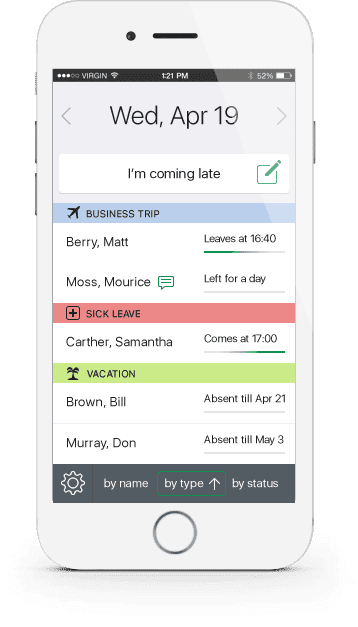
Employees handle their own leave requests through the web interface or mobile app. They see their PTO balance, submit requests in a few taps, and get notified when those requests are approved or declined. Managers get the same data plus absence trend reports that show who takes the most time off and when.
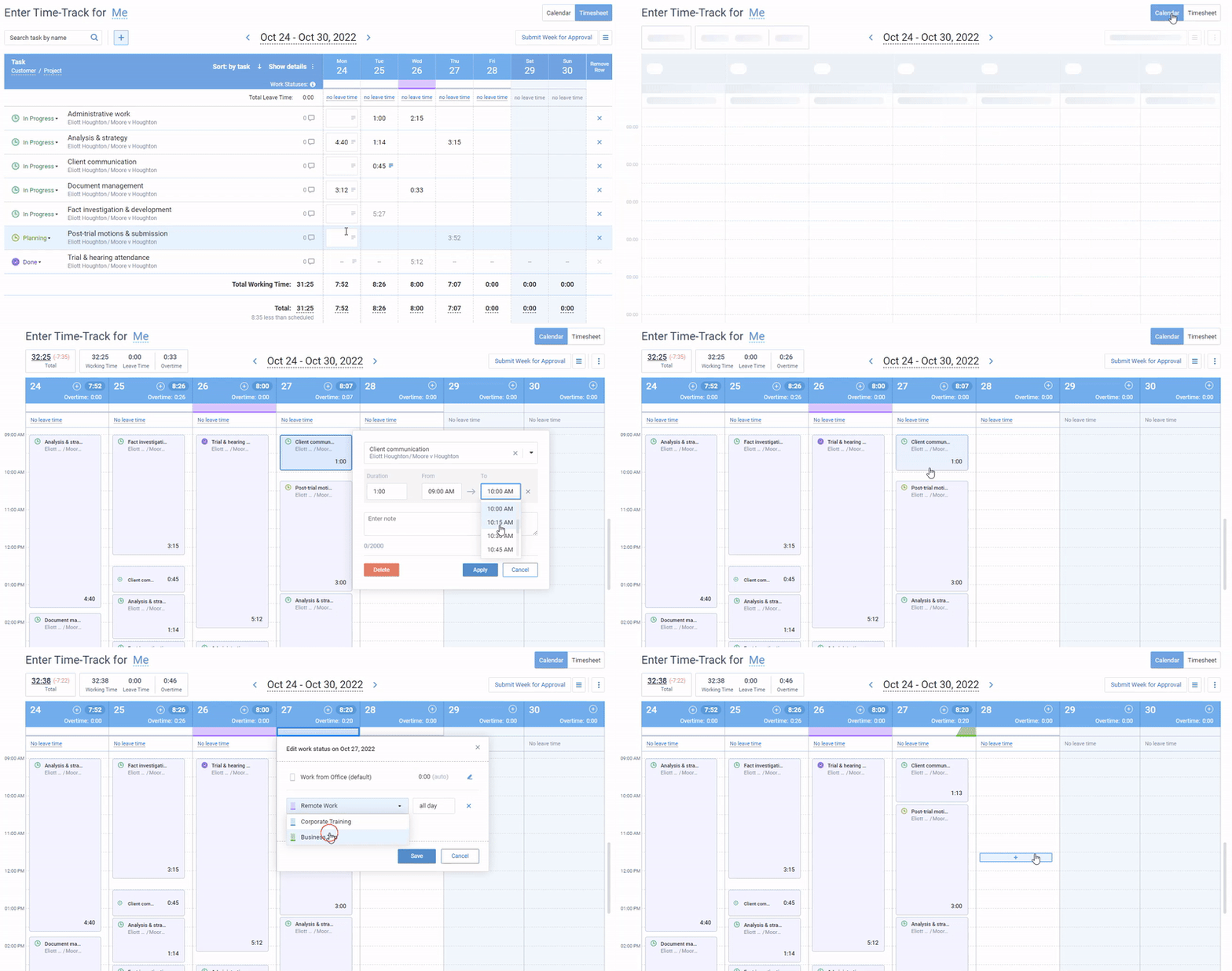
PTO accrual runs automatically. You set the rules (accrual rate, frequency, rollover caps), and the system updates every employee’s balance without manual calculations. For teams that also track hours, actiPLANS integrates with actiTIME to combine absence management and time tracking in one ecosystem.
- Free for up to 3 users, paid plans from $1.50/user/month
- Visual timeline for leave and work scheduling
- Automated PTO accrual and balance tracking
- Mobile app with self-service leave requests
Start a free trial to see how the scheduling and leave management works.
I found in actiTIME all the requirements I was looking for. We are getting a lot of benefits – the tool enables us to better balance workload, have a constant view of what people are doing. I really recommend it, I evaluated a lot of tools, also had an in-house development before which demanded a lot of maintenance, and actiTIME solved all problems with no hassle.
Rippling
Rippling is a unified platform that connects HR, IT, and payroll. The attendance management module handles clock-ins, shift scheduling, and timesheet approvals, and it feeds directly into Rippling’s payroll engine so hours worked turn into paychecks without manual data transfer.
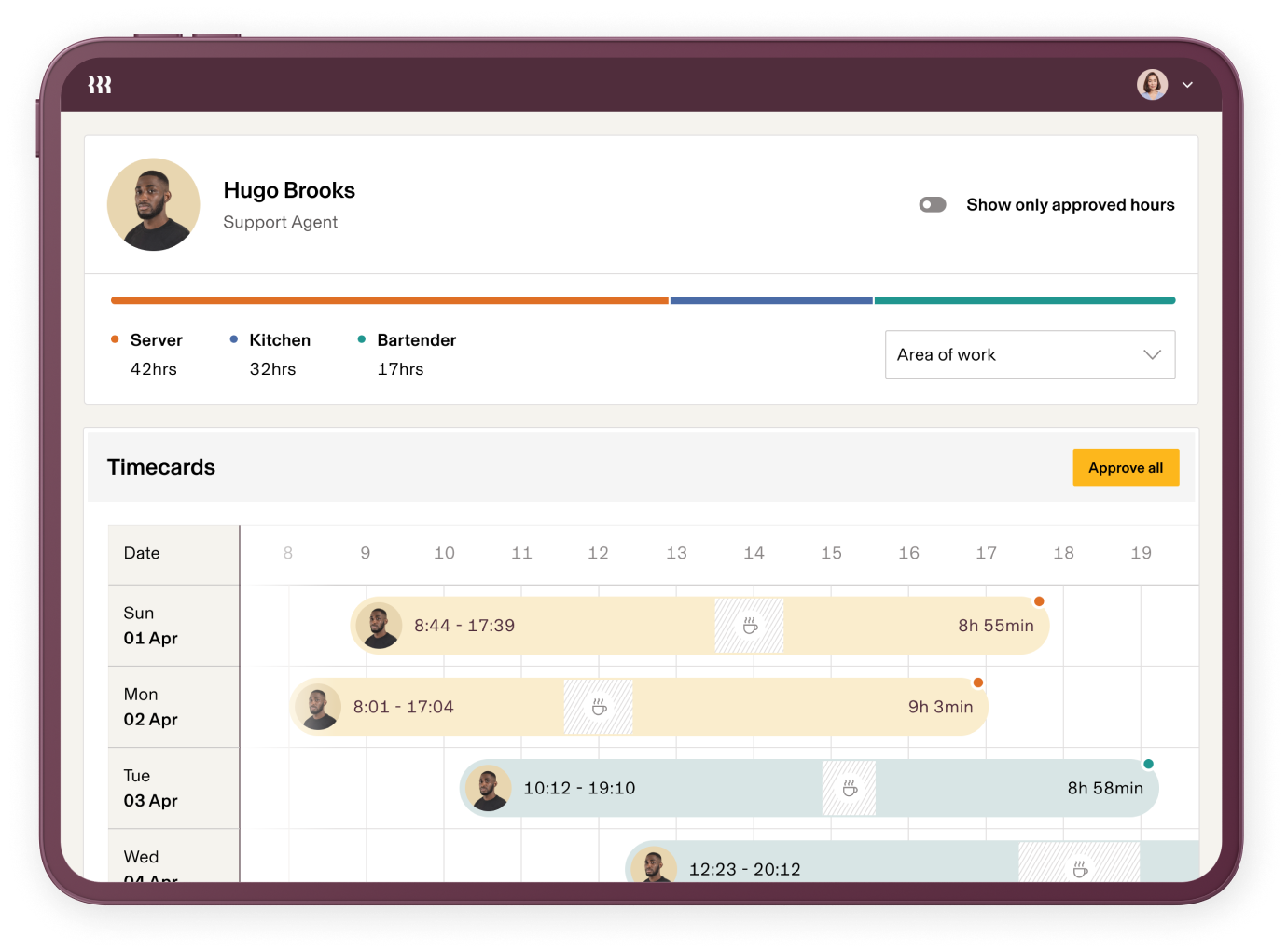
Geofencing and IP restrictions let you control where employees can clock in. Managers can compare scheduled shifts against actual attendance and flag discrepancies automatically. The system also tracks overtime rules by state, which matters for companies with employees in multiple US jurisdictions.
Rippling is best suited for mid-size to large companies (50+ employees) that want attendance, payroll, benefits, and device management under one roof. Smaller teams may find the platform more complex than they need.
- From $8/user/month
- Geofencing and IP-based clock-in restrictions
- Built-in payroll with state-specific overtime rules
- Unified HR, IT, and finance platform
Factorial
Factorial started as an HR platform for European SMBs and added time tracking along the way. Employees clock in from the mobile app or desktop, fill out digital timesheets, and submit leave requests. Managers review and approve everything from a central dashboard.
Shift management lets you create shift types and assign them to employees, with automatic notifications when schedules change. The system calculates total hours (regular, overtime, holiday) and exports the data for payroll processing. Factorial also covers onboarding, document management, and performance reviews, so attendance is part of a broader HR workflow.
Factorial targets small to mid-size companies in Europe and the Americas. Pricing is per user with annual billing, and the feature set grows with each tier.
- Business plan from $6.20/user/month (billed annually)
- Mobile and desktop clock-in with digital timesheets
- Shift scheduling with automatic notifications
- Full HR platform with onboarding and performance
Keka
Keka is an HR and payroll suite with a full attendance management module. It supports web-based clock-in, mobile GPS tracking, and integration with biometric devices. The system tracks tardiness, early departures, and overtime against company-defined rules and generates compliance reports automatically.
Shift scheduling is where Keka stands out. You can create rotating shift patterns, automate shift assignments, and let the system handle swaps. Employees see their schedules on the app and get reminders before shifts start. For large teams with complex shift structures (manufacturing, healthcare, hospitality), this saves significant planning time.
Keka requires a minimum of 100 users on its base plan, which starts at approximately $5/user/month. This makes it a poor fit for small teams but a competitive option for large organizations that want HR, payroll, and attendance in one system.
- From $5/user/month (100-user minimum)
- GPS tracking and biometric device integration
- Automated rotating shift scheduling
- Built-in payroll and compliance reporting

Eddy
Eddy is an all-in-one HR platform for small businesses. The time and attendance module lets employees clock in from the mobile app or desktop, and managers can approve timesheets and time-off requests from the same interface.
The shared team calendar is Eddy’s most useful attendance feature. Everyone sees who is on vacation, who called in sick, and when personal milestones (birthdays, work anniversaries) are coming up. This visibility helps managers plan coverage and avoid scheduling gaps.
Eddy also includes hiring, onboarding, document storage, and (on higher tiers) payroll. It is designed for small businesses with 10 to 200 employees that want one platform instead of separate tools for each HR function.
- From $6/user/month
- Shared team calendar with absence visibility
- Mobile and desktop time clock
- Hiring, onboarding, and payroll on higher tiers
ClockIt
ClockIt is a time clock app with geolocation, geofencing, and biometric punch-in. Employees can clock in from the web, mobile app, Slack, Microsoft Teams, or Google Chat. For physical workplaces, ClockIt offers a kiosk mode with fingerprint and facial recognition to prevent buddy punching.
The software tracks hours by project and task, schedules shifts, and manages vacation requests. Reports break down attendance data by employee, department, or time period, and the data exports to payroll systems.
ClockIt is a mid-range option that balances features with affordability. It covers more ground than basic free tools but does not try to be a full HR platform.
- Free 14-day trial, from $2.99/user/month
- Biometric kiosk with fingerprint and facial recognition
- Clock-in via web, mobile, Slack, or Teams
- Project-level time tracking and shift scheduling
All Hours
All Hours targets remote and hybrid teams specifically. The mobile app includes geofencing and GPS tracking, so managers can verify that employees are working from their expected locations. The web version has a team calendar for planning longer-term absences.
All Hours calculates working hours, overtime, and break compliance automatically. Leave management is built in: employees submit requests, managers approve, and balances update. The system also generates payroll-ready reports.
Pricing is structured around small teams. The base package covers up to 5 users for a flat monthly fee, which works well for micro-businesses. Larger teams pay per user.
- From approximately $3.50/user/month (base: €17.50 for 5 users)
- GPS and geofencing for remote verification
- Automatic overtime and break compliance tracking
- Team calendar for absence planning
TimeClick
TimeClick is an on-premise time clock software sold as a one-time purchase. Employees punch in and out with a single tap. Managers create schedules, track punctuality, and handle missed punches from an admin dashboard.
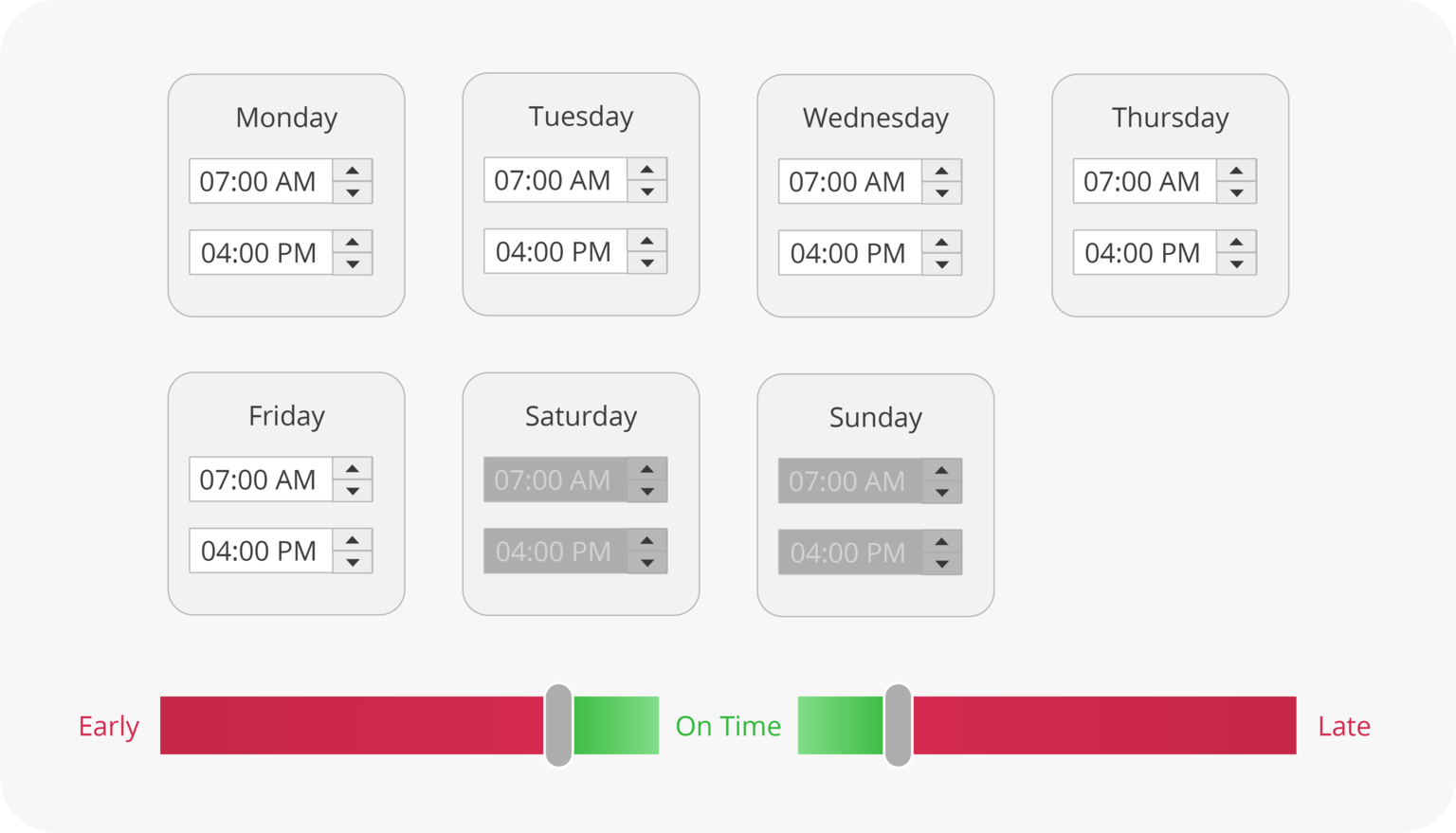
The grace period setting is worth noting: you can add buffer time around shift starts and ends so early arrivals or slightly late clock-ins are not flagged as exceptions. This reduces false alerts and keeps attendance reports focused on real issues.
The one-time pricing ($249 to $999 depending on device count) makes TimeClick unusual in a market dominated by monthly subscriptions. For small teams that want a simple clock-in system without recurring fees, it is worth considering. The trade-off is that ongoing support costs extra.
- $249 to $999 one-time purchase (support plans separate)
- On-premise installation, no cloud dependency
- Grace period settings to reduce false attendance flags
- Mobile app available for remote clock-in
What to Look for in Attendance Management Software
Clock-in methods. Consider how your employees will record attendance. Office-based teams may use a shared kiosk or biometric device. Remote workers need a mobile app or web-based clock-in. Some tools offer multiple methods (ClockIt, All Hours); others focus on one approach.
Leave management depth. Basic tools let employees request time off. More advanced systems (actiPLANS, Factorial, Eddy) handle automatic PTO accrual, balance tracking, rollover rules, and multi-level approval workflows. If your company has complex leave policies, check that the software can model them.
Shift scheduling. Teams with rotating or variable shifts need scheduling features. Keka and ClockIt offer automated shift rotation. Factorial and Rippling handle fixed and custom schedules. If your team works standard hours with no shifts, you can skip this and save on cost.
Payroll integration. Attendance data needs to reach your payroll system eventually. Rippling, Keka, and Eddy include built-in payroll. Others export timesheet data to tools like QuickBooks, Gusto, or ADP. Check that the integration path exists before committing.
Pricing model. Monthly per-user pricing is standard. Free tiers (actiPLANS for 3 users) work for very small teams. Flat monthly fees (like some Connecteam plans) become cheaper as teams grow. TimeClick’s one-time purchase eliminates recurring costs entirely. Match the model to your team size and budget.
FAQ
What is attendance management software?
Attendance management software is a tool that tracks when employees work, takes time off, and reports absences. It automates tasks that HR teams otherwise handle manually: logging hours, calculating PTO balances, routing leave requests, and generating payroll reports.
What is the difference between an attendance management system and a time clock?
A time clock records when employees start and stop working. An attendance management system does that plus leave management, schedule planning, compliance reporting, and payroll integration. A time clock is one component of a broader attendance system.
How much does attendance management software cost?
Most tools charge $2 to $8 per user per month. Free plans exist for small teams (actiPLANS covers up to 3 users). Enterprise platforms like Rippling and Keka cost more but bundle HR, payroll, and IT management. TimeClick is an outlier with a one-time purchase model ($249 to $999).
Can attendance software replace manual timesheets?
Yes. Automated clock-in/clock-out, digital timesheets, and automatic hour calculations eliminate the need for paper or spreadsheet-based tracking. The accuracy improvement alone typically justifies the cost for teams with more than 5 employees.
What features should small businesses look for?
Start with the basics: mobile clock-in, leave request workflow, PTO balance tracking, and a team calendar. Avoid paying for enterprise features (custom API access, SSO, complex shift rotation) until your team actually needs them. Free or low-cost tools like actiPLANS, ClockIt, and All Hours cover the essentials without overhead.
Start a free actiPLANS trial to automate your attendance management and stop tracking hours by hand.